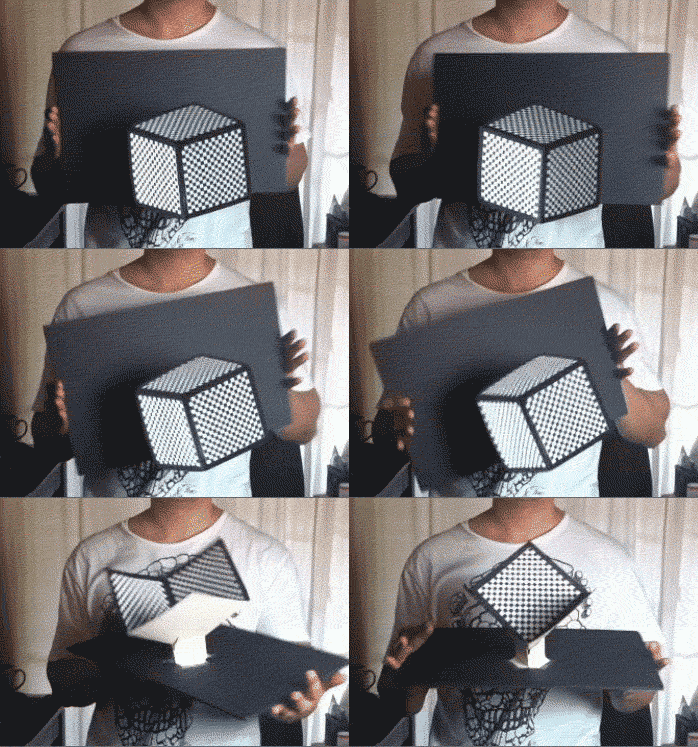
Emily Meneghin '15, studying in Padova Italy this semester, sent me this amazingly cool illusion from some anonymous tumblr* site.

* I had originally spelled this word "correctly". Then Emily nudged me:
"I think, however, it's 'tumblr' rather than 'tumbler,'
just to satisfy the hip kids." Go, hip kids! (The site she sent me is here).
Or it might remind us of an even more modern artist, Patrick Hughes, who creates “reverse perspective” pieces, where the front of a folded canvas seems to be the back, and vice versa. Norman D. Cook is a professor of informatics who studies Hughes’ work and creates his own reverse perspective pieces. These pieces have an eerie sense of motion to them.
What's going on here? Clearly there's some interesting perceptual psychology. But there's also a deliberate use of perspective: the shapes of the trapezoids have the short side near us, but "short" computes in our brains as "far". And the trapezoids have the tall side far from us, but "tall" becomes "near".
Even in the Tumbler video, where none of the lines appear to be vertical, we can use distance to fool the eye. Notice this last frame; the thing that looks like a square is really a diamond, shorter than it is wide. All the extra markings in the interior reinforce the sense of shape, and hence the illusion.
.tiff)
So we see the pieces as being backwards from how they actually sit in that lovely three-dimensional world of ours.

No comments:
Post a Comment
Note: Only a member of this blog may post a comment.